The Wandering Sailor Who Won the Nobel Prize
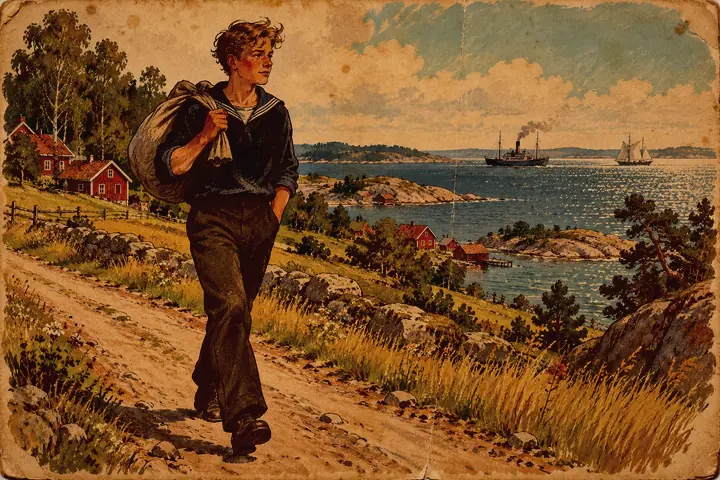
Harry Martinson was born in 1904 in Jämshög, in the Swedish province of Blekinge, one of seven children. His father, a merchant, died of tuberculosis, and his mother then emigrated to the United States, leaving the children to be placed with foster families in the countryside. The Nobel Prize biography describes a restless childhood spent in a series of children's homes and institutions, from which he ran away more than once.
At sixteen he went to sea. For the next six years he worked on different ships and in places abroad. The Nobel Prize facts page describes his youth as that of a seaman and wanderer, with no fixed home and no steady employment. It does not give dates or specific places for the periods when he had nowhere to live.
In 1927 he contracted tuberculosis and left the sea to become a writer. His first books were two prose works about life aboard coal-fired ships in the 1920s. A few years later he published semi-autobiographical books about the experience of a child placed in foster care and how that child made sense of the world. He also wrote poetry collections and nature prose, which he described as thinking out in the meadow.
His later novel Vägen till Klockrike looks at the tension between people who settle and people who keep moving. His best-known work, the epic poem Aniara from 1956, imagines a spaceship that leaves a devastated Earth and drifts off course, reflecting worries about where humanity is heading.
In 1974 he shared the Nobel Prize in Literature. The citation praised writings that catch the dewdrop and reflect the cosmos. He died in Stockholm in February 1978, having turned a childhood without a stable home and a youth at sea into one of Sweden's most admired bodies of work.
- The Nobel Prize — «Harry Martinson – Facts»
- The Nobel Prize — «Harry Martinson – Biographical»